
Invisibility Literacies Series: 1st in Series
August 23, 2022 – Mary Pettit, NBCT, Ed.D
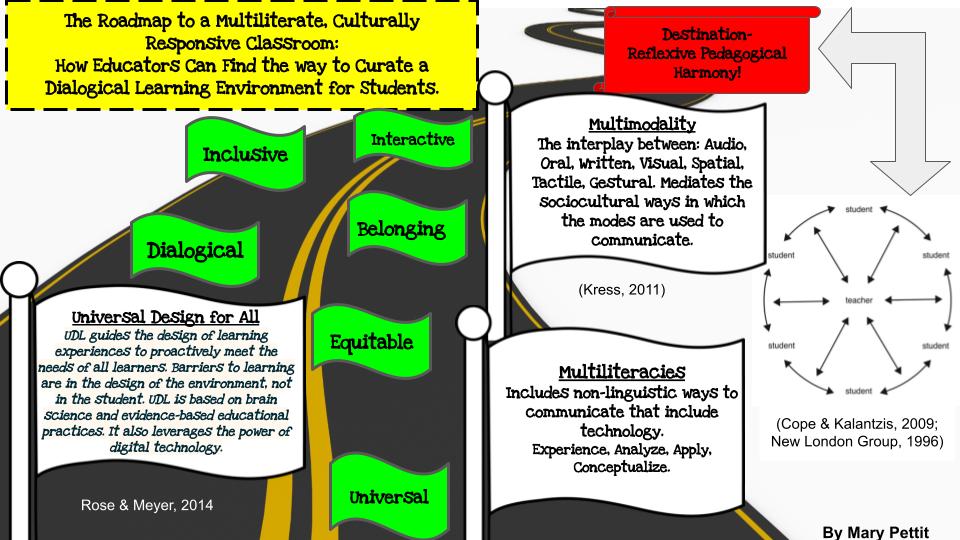
Note: This is the first post in a new “Invisible Literacies” series. Each post will cover one of the 3 major concepts relating to invisible literacies. All posts will be rooted in research, grounded in theory, and focused on best practice. This series is meant to enlighten educators and educational leaders about the multiliteracies that unfortunately go unnoticed and remain invisible throughout curriculum, pedagogy, and practice. Adopting an invisible pedagogical framework causes individual student literacies to remain hidden. The first post in this series will address invisible literacies pedagogy and discuss research to support the harmful impact of its use. The second post in this series will address multimodal approaches and universal design for learning grounded in research and applied in classrooms. The third post in this series will be dedicated to educators who have implemented best practices in their classrooms and embrace/acknowledge all literacies so that all students have equitable access and opportunities to learn. My goal is to provide a clear and concise definition of invisible literacies so that we can start with equitable learning goals for all students while envisioning and devising a sound pedagogy that follows a roadmap leading to the hidden treasure: EQUITY IN LEARNING.
Invisible Literacies Defined
Invisible literacies are those that account for all knowledge practice and skills within and outside of school that are either unacknowledged or discouraged in the classroom.
Hamel (2006)
Any pedagogical practice that builds up barriers of invisible literacies continues to perpetuate inequality and excludes historically marginalized students and ultimately prevents learning for all. Schools and educators that do not recognize “multilingual, multimodal, and pragmatic literacies as a measure of competence and success” (Kiramba, 2017, p. 267-277) limit literacy opportunities to students that fall within standardized definitions of institutional understandings. The path to reflexive dialogical harmony is difficult to navigate when pedagogical practice comes from a place where visible pedagogy and standard educational practice serve only those with visible literacies (Diehl, 2016).
A Real Life Example
If you know the story of William Kamkwamba, The Boy Who Harnessed the Wind and you share my sentiments, you were probably moved to tears for how he and his family suffered but at the same time undoubtedly inspired beyond words at, despite his incredible literacies and talent that went unnoticed and remained invisible, his perseverance and drive to succeed broke down barriers that shed light on the way educators and researchers view literacies in classrooms around the world.
William Kamkwamba was born August 5, 1987 in Dowa, Malawi, and grew up on his family farm in Masitala Village, Wimbe, two and half hours northeast of Malawi’s capital city. The second eldest of Trywell and Agnes Kamkwamba’s seven children, William has six sisters.
William’s literacies went beyond traditional reading and writing expectations as outlined in the curriculum. He had multi-literacy talents including technological innovation, science, and visual/spatial ability. Like other children from economically disadvantaged communities, William’s literacies remained invisible. When given standard assessments meant to measure his reading and writing ability, he was labeled inadequate. When he tried to demonstrate his passion for building and technological innovation, he was told that his reading and writing skills were not up to standard. After completing 8th grade at Wimbe school and about to attend Kanchokolo secondary school the severe famine in 2001-2002 changed the course of his life. His family lacked the funds to pay the $80 in annual school fees and William was forced to drop out of school midway through his freshman year. For five years he was unable to go to school.
Starting at 14, rather than accept his fate, William started borrowing books from a small community lending library located at his former primary school. He borrowed a 5th grade American textbook called Using Energy, which depicted a wind turbine on its cover. He decided to build a windmill to power his family’s home and obviate the need for kerosene, which provided only smoky, flickering, distant and expensive light after dark. First he built a prototype, then his initial 5-meter windmill out of a broken bicycle, tractor fan blade, old shock absorber, and blue gum trees. He was able to power four light bulbs and two radios, and charge neighbors’ mobile phones. He then rebuilt a 12 meter windmill to better catch the wind above the trees, and added a car battery for storage, as well as homemade light switches and circuit breakers. He also experimented with building a radio transmitter to broadcast popular music interspersed with HIV prevention messages.

“If you want to make it, all you have to do is try.” “Don’t insult me today just because I’m poor, you don’t know what my future holds!” “BEFORE I DISCOVERED THE miracles of science, magic ruled the world.” “Whatever you want to do, if you do it with all your heart, it will happen.”
William Kamkwamba
I chose to share William Kamkwamba’s story to illustrate the dangers of practicing invisible literacies pedagogy. Although a world away and decades later, there are many students just like William in classrooms throughout our country today. It is likely that if you are reading this post and you are an educator or an educational leader, you can expect to have students just like William grace the hallways of your school and your classroom in the coming weeks. Students whose literacies go unnoticed and unacknowledged are forced to find ways to break down the barriers that our educational system continues to build. Grassroots educators and educational leaders who are bold enough to advocate for all students can help break down these barriers so that they have equitable opportunities to learn, grow, and achieve. This series will be dedicated to helping each other learn how to lead at the grassroots level. I hope you will join me on this journey!
 Universal Digital Literacy Solutions, LLCoo IPO IPO oooooòoo ooo o ooo I I I ooo ooo I iio
Leave a comment