
September 2, 2022 ~ Mary Pettit, NBCT, Ed.D
This post is dedicated to my grandmother, Mary Cinquemano. If it were not for her, my scolapasta skills would not be what they are today. I am forever grateful for her unconditional and unwavering love.

Prologue
The “Buzz Word” Train
Sometimes I feel like I am the conductor of the educational “buzz-word” train making several stops each year to welcome aboard the newest “buzz-word” passengers. This past decade it seems like the train is “standing room only” and the steam from my brain is what propels it forward. Two years ago I began to feel disconnected from my “passengers” and to the job I remembered loving. I knew that if I stopped the train or disrupted its course, I was taking the risk of no longer being in compliance. Ultimately, my job was to get my passengers from point A to point B in a timely manner but I was struggling with the feeling that I had no idea why. What was my purpose? Transporting unknown passengers for an unknown or misunderstood purpose began to take a toll on me.
So…I stopped the train.
I vowed to get to know my “buzz-word passengers” and their stories and quickly realized that in doing so I was not only reminded of my own purpose (my why) but others began to realize theirs too. As new “buzz-word” passengers got on the train, I took the time to get to know them. Although not a timely arrival to their destination as they might have been if I had just put the pedal to the metal and waited for them to get off and checking the “I-am-compliant-but-clueless” box on a long list of “job duties.”
I met and listened to the stories of many “buzz word” passengers including…pedagogy, critical race theory, advocate, empower, multilingual, multicultural, restorative practice, STREAM, collaboration, coteach, leadership, initiative, standard, self-efficacy, mindset, autonomy, self-regulation, self-assessment, locus of control, discourse, theory, and my most recent passenger…culturally responsive teaching. When I sat down to unpack what I learned from this passenger, I was reminded of something that happened to me when I was in 7th grade Home Economics class.
1987 ~ 7th Grade Home Economics
I walked into Home Economics class not really knowing what to expect. Rumor had it that we were going to learn how to sew and cook so I thought “how bad could this be?”. When I walked into the classroom, I immediately noticed a long banquet table in front of the room. On top of the table were random kitchen tools. Curiously and cautiously I found a seat and anticipated what the teacher was going to say and do. (I don’t remember her name so I will call her Mrs. Smith). Mrs. Smith said that she would call students by row to come up and take one familiar item off the table to bring back to our seats. When everyone had an item, Mrs. Smith instructed us to name it and explain to the class what it was used for.
Wow! I immediately saw the item I would take. The only problem was, I was seated in the third row so there were several students that would choose before me as she was calling students to come up in order starting with the first row. My heart started to race because I wanted the item I had my eye on so badly. It wasn’t that I didn’t know any other items on the table. I knew plenty of them as my grandmother taught me a lot about what tools were used in the kitchen. But…this tool…this one was special to me.
My grandmother allowed me to use it every Sunday when we made fresh sauce, meatballs and pasta together. It had a funny name that I never heard any of my friends say when they referred to it. I thought, “This is my chance to impress the teacher with my kitchen tool knowledge.” Additionally, I immediately thought of my grandmother and all the memories we shared together before she died.
It’s my turn! This is it! No one took the item I wanted! I felt a flutter of excitement as I darted out of the chair, raced to the table, and snatched up the tool. Proudly, confidently, and with an air of smugness I turned around and rehearsed what I would say in my head so I would be ready. Brian went first. He took a can opener and explained what it was used for. Jennifer went next. She took a whisk and explained how she uses it to mix pancake mix (she even knew that it helped break up the lumps). “Big deal, I thought…everyone knows that”…eye roll (I was 13). One by one I listened to more classmates as they held up the item they chose and explained. I tuned most of them out because I was excited to share my item and to impress the teacher with my knowledge.
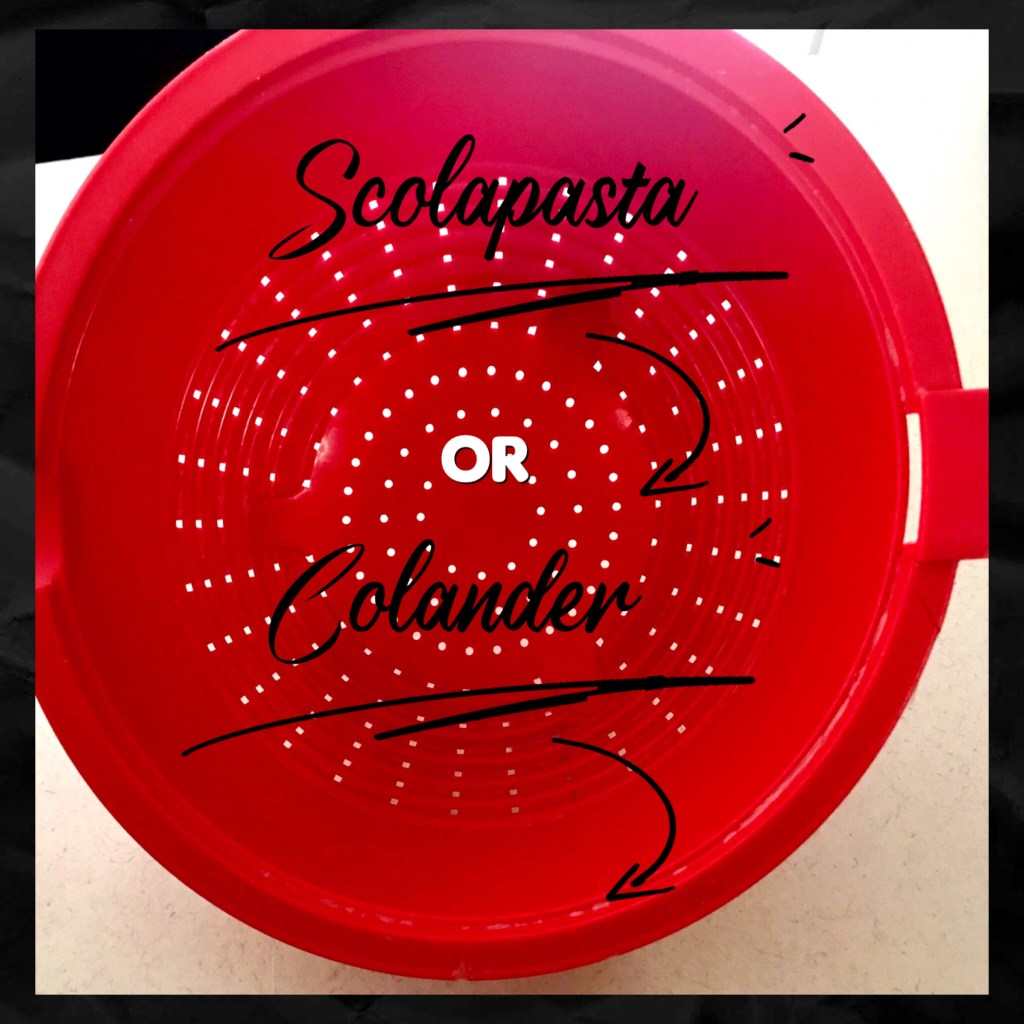
When it was my turn, I proudly held the item in the air. I said “this is a scolapasta” (sk-ool-ah-pah-st), it is used to strain the cooked spaghetti. My grandmother allows me to hold the scolapasta over the sink while she carefully pours the boiling water in it. When the water is almost gone, the spaghetti plops in the scolapasta and I shake it to get the rest of the water out before returning it to the pot. Then my grandmother pours sauce over the cooked pasta so it won’t stick.”
I didn’t realize that the room was completely silent because everyone was staring at me like I was crazy…including Mrs. Smith. She looked as if I stepped off a spaceship. I thought the room was silent because what I said was so impressive. Why wasn’t anyone taking notes on what I said? I even spelled it for them. S-C-O-L-A-P-A-S-T-A. I mean…what’s the problem?
I saw Mrs. Smith’s brows turn inward to meet her crinkled eyes, the corners of her lips turn down, and her hand reach for her heart. I knew that the quiet in the room wasn’t something to be proud of. Then, she cleared her throat and looked at me with pitying eyes and said, “Mary, that kitchen tool is called a colander. While you are correct in explaining what it is used for, we don’t call it…what you said…here. We call it a colander.” I felt my throat close and tears begin to well up in my eyes. I tried so hard to drown out the snickers from my classmates and to forget what just happened. What does here even mean? In this room, in the school, in our community, the state, the country…WHERE IS “HERE?”
I heard nothing that Mrs. Smith said that day, the day after, and for the rest of the semester for that matter. At the time, I didn’t understand that weird feeling in my stomach everytime I walked into her class. I didn’t understand why I was afraid to raise my hand or ask any questions. As a matter of fact, I hadn’t really thought of that memory until I met “culturally responsive teaching,” a passenger on my train.
Culturally Responsive Teaching
Culturally Responsive Teaching is a term coined by Geneva Gay in 2000 to describe an asset based pedagogical approach that aligns best teaching practice with the customs, characteristics, and perspectives of students’ lived experiences. Gay’s work stems from scholar Ladson-Billings (1990) theoretical framework “culturally relevant pedagogy” which states that teaching should foster acceptance, celebrate and acknowledge students cultural identity, and develop ways to model critical thinking. Will and Najarro (2022) state that although asset based pedagogies can vary, they all “have the same goal of dismantling a deficit approach” (p. 7). Culturally responsive teachers focus on student strengths, assets, and a culture of community in the classroom.
So readers, I ask you…Do you believe Mrs. Smith used a culturally responsive approach to teaching when she corrected my understanding of a colander? If not, how might that scene have played out differently in your classroom? How can educators redefine the “here” that Mrs. Smith defined back in 1987?
I am challenging readers to weigh in on this topic. I challenge you to redefine the “here,” get to know those “buzz-words,” and stop to remember why you love what you are doing. I am truly excited to hear your experiences and thoughts.
Remember…



 Universal Digital Literacy Solutions, LLCoo IPO IPO oooooòoo ooo o ooo I I I ooo ooo I iio
Leave a comment