


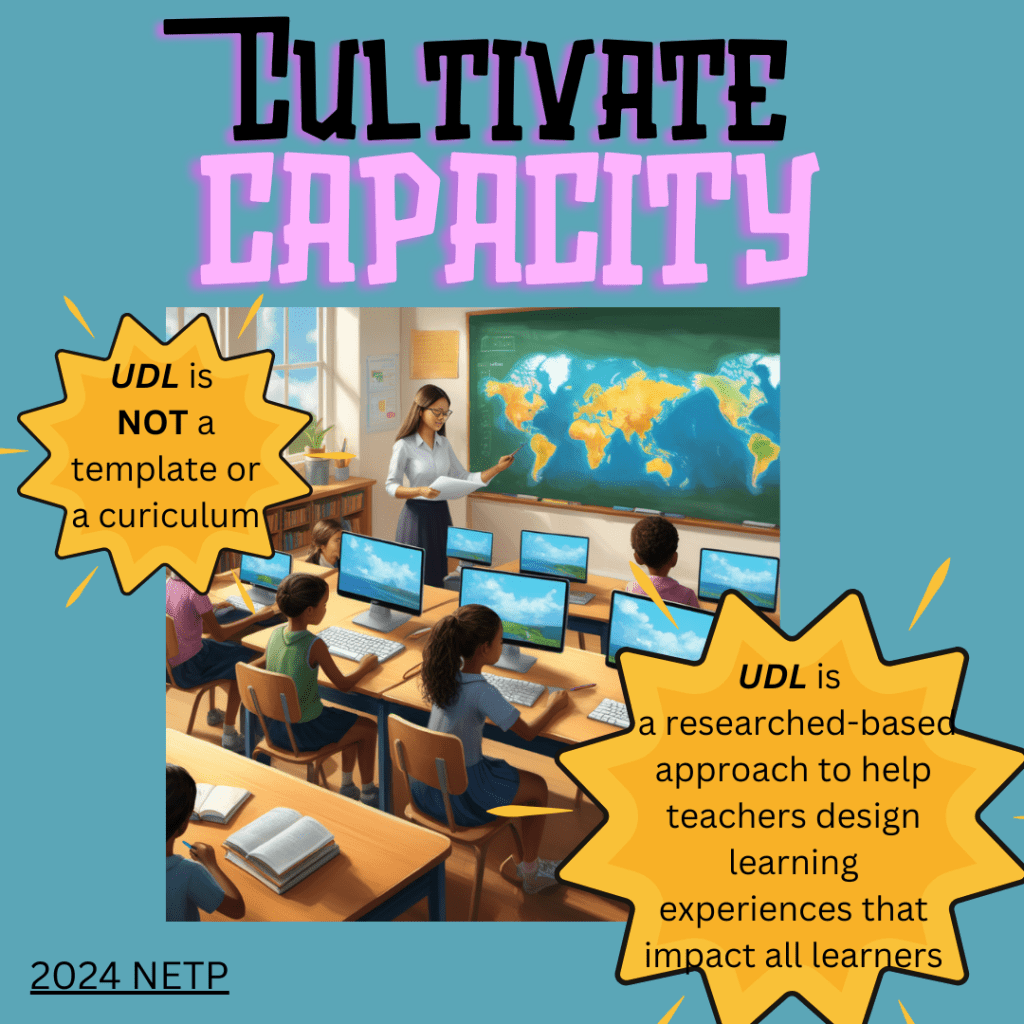
How can district and school leaders cultivate teacher and administrative capacity to empower educators to effectively implement UDL in their classrooms?
- Optimize individual choice and autonomy: (UDL Checkpoint 7.1)
- Provide teachers with the agency to adapt UDL implementation to their unique classroom contexts and student needs.
- Encourage teachers to experiment with UDL strategies and share their experiences with their peers.
- Offer personalized professional development opportunities based on teachers’ interests and areas of growth.
- Vary demands and resources to optimize challenge: (UDL Checkpoint 8.2)
- Introduce UDL concepts and strategies in manageable, scaffolded steps, avoiding overwhelming teachers with too much information at once.
- Offer differentiated supports, such as mentoring, coaching, and collaborative planning time, to help teachers build their UDL expertise.
- Provide access to a variety of resources, tools, and exemplars to inspire and guide teachers in their UDL implementation.
- Minimize threats and distances: (UDL Checkpoint 9.3)
- Address potential sources of stress or anxiety associated with UDL implementation, such as lack of time, training, or resources.
- Foster a supportive and collaborative school culture where teachers feel comfortable taking risks and sharing their UDL successes and challenges.
- Ensure that UDL initiatives are aligned with broader school or district goals, minimizing the sense of “initiative fatigue.”
- Activate or supply background knowledge: (UDL Checkpoint 3.1)
- Provide comprehensive, ongoing professional development on the principles and practical application of UDL.
- Ensure that teachers have a clear understanding of the research-based foundations and benefits of UDL.
- Offer opportunities for teachers to observe and learn from model classrooms or expert UDL practitioners.
By applying these UDL-aligned strategies, education leaders and administrators can cultivate a culture of innovation, collaboration, and continuous growth among teachers. This, in turn, will empower educators to confidently and effectively implement UDL in their classrooms, leading to more inclusive and engaging learning experiences for all students.
UDL Tips for Designing Learning Experiences:
- Start with a clear goal.
- Encourage flexible means to achieve the goal.
- Ensure all learners can access the materials and environment.
- Make learning personally relevant.
- Promote expert learning.

CAST (2020).UDL Tips for Designing Learning Experiences. Wakefield, MA: Author. Retrieved from https:
//www.cast.org/products-services/resources/2020/udl-tips-designing-learning-experiences
Novak, K., & Rodriguez, K. (2016). UDL progression rubric. CAST. UDL Checkpoints Progression Chart Download
 Universal Digital Literacy Solutions, LLCoo IPO IPO oooooòoo ooo o ooo I I I ooo ooo I iio
Leave a comment